

First Cohort of Emergency Telecommunicators Graduates
By: , March 19, 2026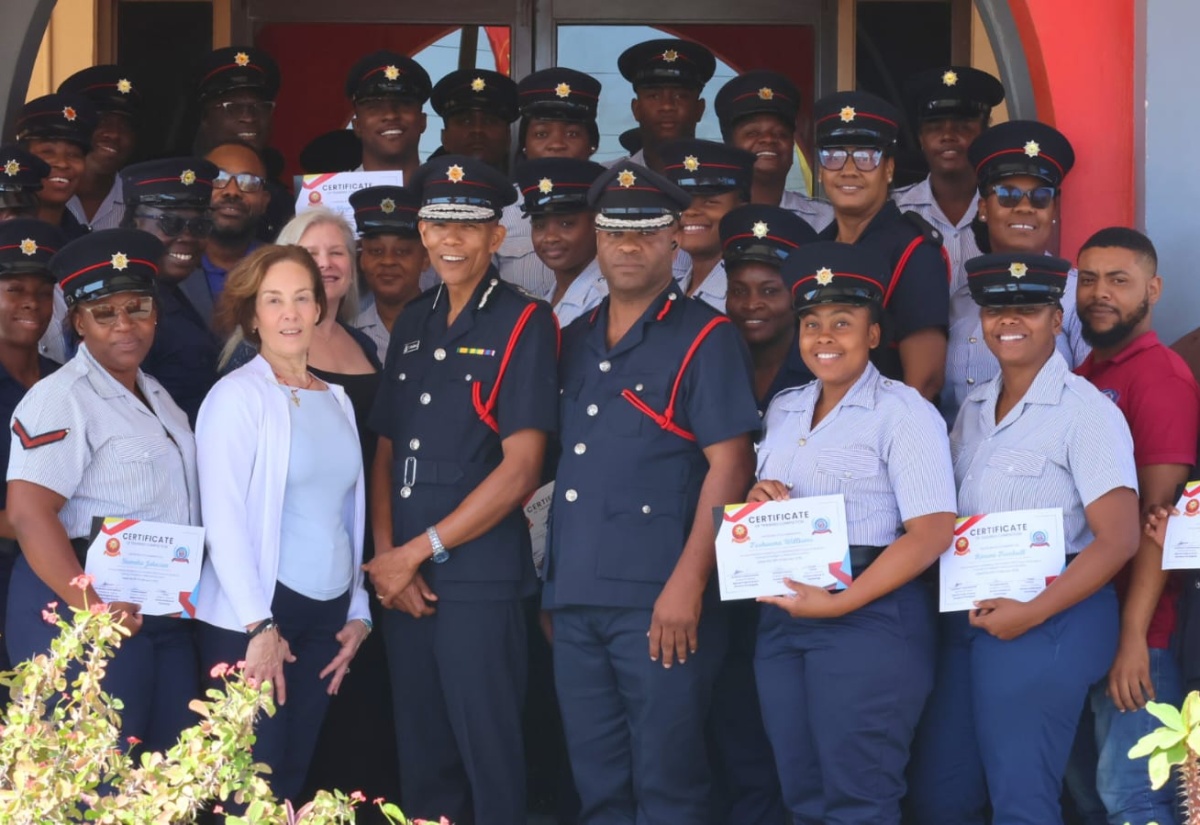
Photo: Contributed
Commissioner, Jamaica Fire Brigade (JFB), Stewart Beckford (fourth left, front row), and Assistant Commissioner, Andrew Russell (fifth left), share a photo opportunity with the first cohort of Emergency Telecommunicators, along with facilitators of the Emergency Telecommunicator Training Programme, following the graduation ceremony in February.The Full Story
The Jamaica Fire Brigade (JFB) has taken a major step towards modernising the country’s emergency response system, with the graduation of its first cohort of 24 Emergency Telecommunicators.
As the first point of contact during fire, rescue and medical emergencies, emergency telecommunicators play a critical role in coordinating response efforts.
Assistant Commissioner, JFB, Andrew Russell, told JIS News that “the graduation of these Emergency Telecommunicators marks the beginning of a new era in the JFB, one defined by professionalism, technological readiness, and a steadfast commitment to protecting lives and property across Jamaica”.
He informed that the graduates will be assigned to the newly established Emergency Communication Centre (ECC), the centralised hub for receiving emergency calls and dispatching fire and rescue units islandwide.
“The deployment of the trained telecommunicators will significantly improve the efficiency and reliability of emergency response services. The ECC is expected to streamline the processing of emergency calls, strengthen inter-agency coordination, particularly with the Jamaica Constabulary Force, and support the overall digital transformation of Jamaica’s emergency management systems,” said Assistant Commissioner Russell.
He noted that the Emergency Telecommunicator Training Programme was developed to create a specialised cadre of professionals equipped to manage high-pressure emergency calls.
“Telecommunicators must demonstrate exceptional communication skills, technical proficiency, situational awareness, and emotional resilience,” Assistant Commissioner Russell said.
Prior to graduation, participants were engaged in a five-week training programme, which combined theoretical instruction with practical, scenario-based training.
Key areas of study included interpersonal communication, ethics and professional conduct, confidentiality and data protection, emergency telecommunications systems, call classification, computer-aided dispatch operations, radio communication techniques, multi-agency coordination protocols, and stress management.
The programme was delivered through collaboration among HEART/NSTA Trust, the JFB, and international partners Winbourne Consulting and Global Emergency Services Consulting Group, at the Gomex Institute of Technology in Portmore, St. Catherine.