

Stakeholders Explore Positive Discipline in Child Rearing
By: , March 8, 2026
Photo: Mark Bell
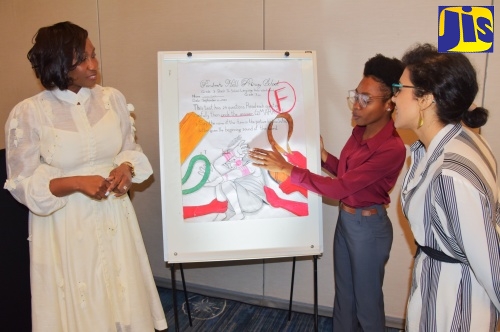
Children's Advocate, Diahann Gordon Harrison (left), shares in conversation involving (from second left), United Nations Children's Fund (UNICEF) Representative in Jamaica, Olga Isaza; student, Edna Manley College of the Visual and Performing Arts, Samelia Sybblis; Child Development Expert, Professor Maureen Samms Vaughn; and President, National Parent-Teacher Association of Jamaica, Stewart Jacobs, at the Office of the Children's Advocate (OCA) Dinner & Conversations event held recently at AC Hotel by Marriott in Kingston.
Photo: Mark Bell
Children's Advocate, Diahann Gordon Harrison (centre), engages in conversation with Child Development Expert, Professor Maureen Samms Vaughn (left) and United Nations Children's Fund (UNICEF) Representative in Jamaica, Olga Isaza, at the Office of the Children's Advocate (OCA) Dinner & Conversations event held recently at AC Hotel by Marriott in Kingston.The Full Story
Stakeholders from government, academia, faith-based organisations and children, came together to examine the impacts of corporal punishment in Jamaica and explore pathways toward positive, more supportive approaches to discipline.
The Dinner and Conversation session, held recently at the AC Hotel by Marriott in Kingston, was organised by the Office of the Children’s Advocate (OCA in partnership with the United Nations Children’s Fund (UNICEF).
Children’s Advocate, Diahann Gordon Harrison, who spoke to JIS News after the event, noted that the objective is to shift societal norms towards non-violent, and evidence-based disciplinary methods in child rearing.
She noted that the forum, under the topic: ‘Discipline that Teaches: Corporal Punishment vs Alternative Discipline’, facilitated conversation on what each approach to parenting can actually achieve, but anchored with evidence of the psychological impact of corporal punishment versus positive discipline.
Corporal punishment, as defined by the United Nations Committee on the Rights of the Child (CRC), is any punishment in which physical force is used to cause some degree of pain or discomfort.
The Committee considers all corporal punishment as inherently degrading, violating a child’s right to dignity, physical integrity and protection from all forms of violence, as guaranteed under Article 19.
Mrs. Gordon Harrison noted that there is a strong cultural bias in Jamaica and several other Caribbean countries towards using corporal punishment, noting that many persons see it as a workable method.
“The Office of the Children’s Advocate sees this Dinner and Conversation as an opportunity to keep the dialogue going, and to have persons who attended to consider different methods that may be more effective. This is even as we grapple with the cultural reality and also the leaning that some persons have for the proverb ‘spare the rod and spoil the child’,” she told JIS News.
The proverb suggests that failing to physically punish children results in them becoming spoiled or ill-behaved.
“We also wanted to put in the mix, the social outcomes of some of these children who, over time, develop mental health issues because of the violent way in which they have been disciplined,” Mrs. Gordon Harrison said.
The event featured a panel discussion, involving a student, teacher, and members of the Rastafari, Christian and Jewish communities, who shared their perspectives and experiences and made recommendations.
The Children’s Advocate said it is hoped that the session contributed meaningful dialogue that can be translated into actionable change.
“We continue, as an office, to lend our support to having a useful public education and sensitisation programme for parents so that they know what some of these workable alternatives are,” she told JIS News.
“We also want to ensure that any particular direction that is being pursued is done in a culturally appropriate way, with all stakeholders understanding the roles they will be expected to play in ensuring that our children are behaving well; that we are using constructive methods to change attitude and make them more compliant with what is acceptable socially,” she added.
UNICEF Representative in Jamaica, Olga Isaza, in her presentation at the session, said that the organisation welcomed the opportunity to support conversation on an important topic.
“This is a space where honest reflection, shared learning, and constructive dialogue can advance the protection and well-being of Jamaica’s children. UNICEF sincerely appreciates the leadership of the OCA in convening this discussion,” she said.
Ms. Isaza cited the 2023 Violence Against Children in Jamaica Survey, which indicates that more than three in four females (77.2 per cent) and males (77.6 per cent) ages 13 to 24 experienced violence during their lifetime. Almost half of females (48.1 per cent) and males (45.7 per cent) experienced physical discipline or verbal aggression from parents over the previous 12 months.
Ms. Isaza said that while the results are sobering, there are important signs of hope, referencing the 2022 Multiple Indicator Cluster Survey, which found that only 16 per cent of mothers and caregivers believe physical punishment is necessary to raise a child.
“This tells us that attitudes are shifting. Many Jamaican parents already recognise that discipline does not have to involve pain to be effective,” she pointed out.
She further cited last year’s UNICEF U-Report poll, where young people said that talking to them calmly and taking away privileges is more effective than instilling fear. They also said that discipline should teach, not traumatise.
“This signals that now is the time to build on this momentum towards positive, nurturing and non-violent approaches to discipline,” Ms. Isaza said.