


Senior Research Fellow Calls for Rights-Based Approach to Reintegration
By: , January 27, 2026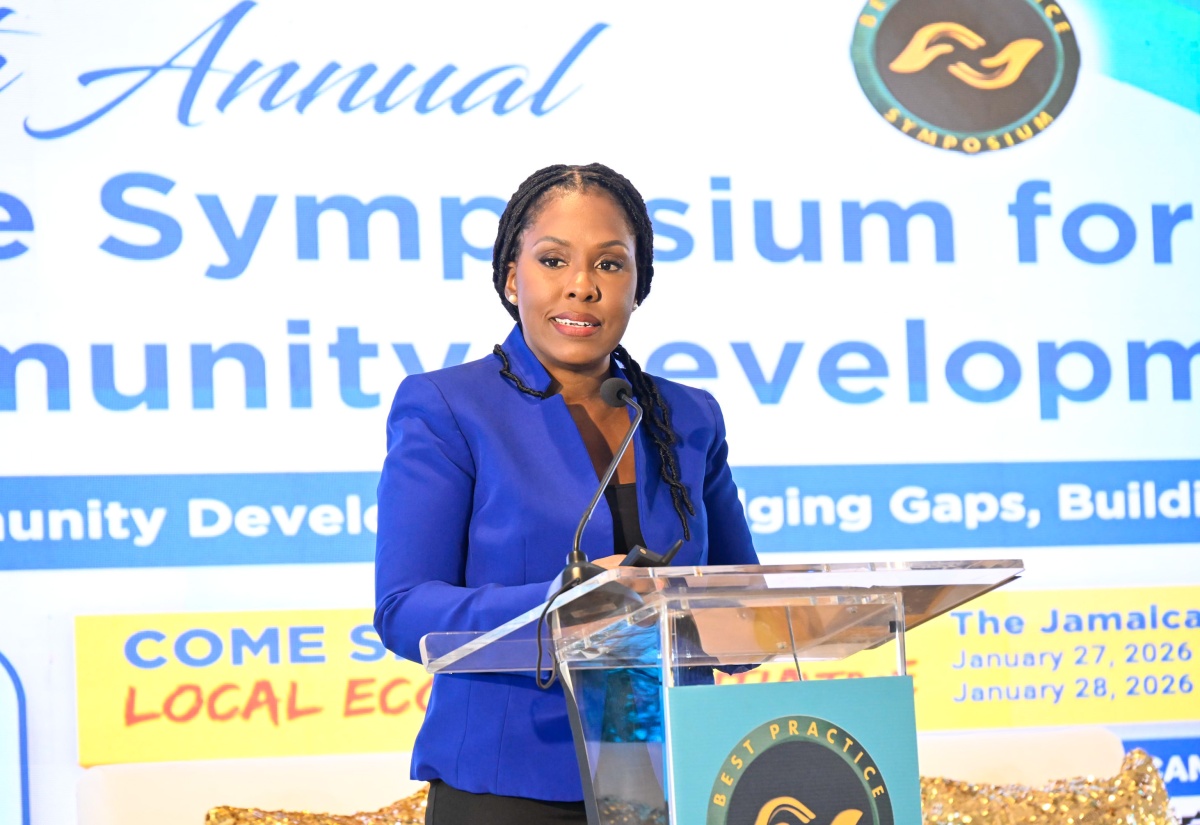
Photo: Donald De La Haye
Senior Research Fellow at the Sir Arthur Lewis Institute of Social and Economic Studies (SALISES), University of the West Indies (UWI), Mona, Dr. Dacia Leslie, addresses day one of the 10th Planning Institute of Jamaica (PIOJ) Best Practice Symposium on Tuesday (January 27), at The Jamaica Pegasus hotel in New Kingston. She was presenting on the theme 'Reintegration for Sustainable Development: Bridging Gaps and Building Futures'.The Full Story
Reintegration must be regarded not merely as a post-release intervention for persons formerly in conflict with the law or involuntarily returned migrants (IRMs), but as a rights-based and inclusive development priority.
This is the position advanced by Senior Research Fellow at the Sir Arthur Lewis Institute of Social and Economic Studies (SALISES), University of the West Indies (UWI), Mona, Dr. Dacia Leslie, as she addressed day one of the 10th Planning Institute of Jamaica (PIOJ) Best Practice Symposium at The Jamaica Pegasus hotel in New Kingston on Tuesday (January 27).
She was speaking under the symposium theme, ‘Reintegration for Sustainable Development: Bridging Gaps and Building Futures’, which highlighted the reintegration of persons formerly in conflict with the law and involuntarily returned migrants (IRMs).
“Reintegration is a core development imperative that sits at the intersection of justice, social protection, labour markets, and human dignity,” Dr. Leslie said.
She explained that reintegration is not a one-time event following release but rather a continuous process that should commence at the earliest stages of contact with the justice system.
Dr. Leslie emphasised that effective reintegration extends beyond individual desistance, requiring deliberate action by institutions and communities to restore rights and dismantle barriers to inclusion.
She underscored that reintegration must not be regarded as a marginal correctional issue, as its outcomes carry significant implications for national development.
“How Jamaican society facilitates reintegration shapes public safety, labour markets, family stability and, ultimately, who we decide belongs in our society,” she stated.
Drawing on evidence from regional and national studies, Dr. Leslie highlighted persistent reintegration gaps, particularly among young people and involuntarily returned migrants.
She referenced findings from a 2018 Inter-American Development Bank (IDB) survey of incarcerated persons in Jamaica, which revealed limited access to education, skills training, and structured pre-release support – challenges most acute among individuals aged 18 to 24.
“These conditions are directly associated with repeat contact with the justice system, particularly for young people returning to already marginalised communities,” she said.
However, Dr. Leslie noted progress achieved through Jamaica’s existing policy frameworks and initiatives, including the National Correctional Services Policy and the Draft National Deportation Policy, which reflect a growing commitment to positioning reintegration as a national development priority.
“The good news is that Jamaica is not starting from scratch. There is a clear momentum with established policy frameworks, active community-based and faith-based initiatives, and growing recognition that reintegration gaps must be addressed in a more coordinated way. Our opportunity lies in connecting and scaling what already exists and strengthening coordination across institutions,” she said.
Dr. Leslie also highlighted the development pressures arising from deportation and forced return, noting that Jamaica continues to receive the largest share of involuntarily returned migrants within the Anglophone Caribbean.
“Deportation and return intensify reintegration demands on already stretched economies; many individuals return without housing, employment, or coordinated support,” she said.
Dr. Leslie referenced the PIOJ’s 2025 Economic and Social Survey of Jamaica, which reported that 547 involuntarily returned migrants were received in 2024, the majority originating from the United States.
She urged a ‘whole-of-society’ approach – engaging government, the private sector, communities, and civil society – to advance reintegration as a national development priority.
“Such partnerships must be based on a recognition that reintegration is effective, not through siloed approaches but through collective leadership and shared accountability over time,” Dr. Leslie emphasised.