



Ghana’s Foreign Affairs Minister Says Country Will Demand Reparations
By: , January 27, 2026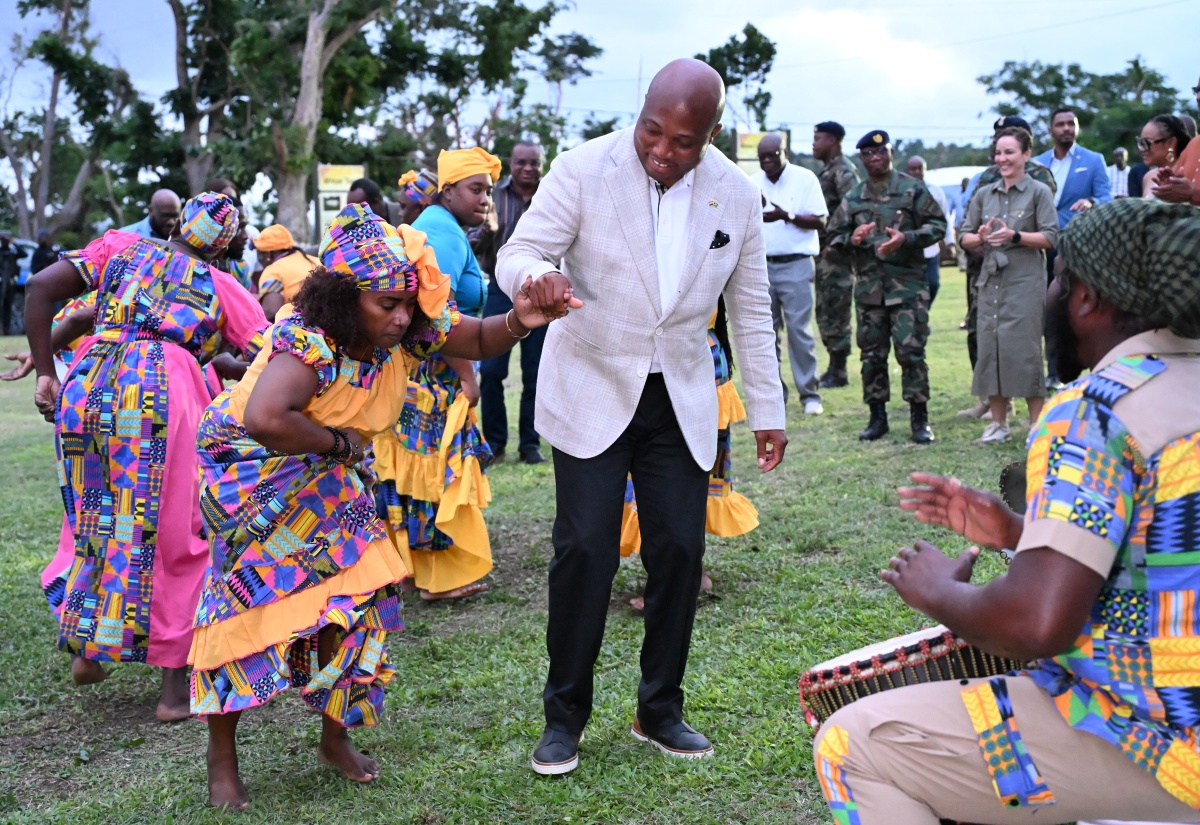
Photo: Contributed
Minister of Foreign Affairs of the Republic of Ghana, His Excellency Samuel Okudzeto Ablakwa (centre), dances with the Charles Town Maroon group during a welcome reception and tour at the Seville Great House in St. Ann, on Sunday (January 25). Observing in the background is Jamaica's Minister of Foreign Affairs and Foreign Trade, Senator the Hon. Kamina Johnson Smith.The Full Story
The Republic of Ghana’s Minister of Foreign Affairs, His Excellency Samuel Okudzeto Ablakwa, says Ghana will demand reparations, emphasising that the call is rooted in justice, healing and closure rather than financial compensation.
He was speaking during a welcome reception and tour at the Seville Great House in St. Ann on Sunday (January 25), which formed part of a visit to the island by a Ghanaian delegation, headed by the Foreign Affairs Minister and comprising other officials from that country.
Minister Ablakwa said the demand for reparations is closely linked to the violent stripping away of African identity during enslavement, noting that Africans were forcibly renamed and disconnected from their cultural and ancestral roots.
“Our identity was deliberately and consciously, violently taken away from us. Every African arriving here was given names that did not belong to us and that had really no meaning,” he underscored.
The Minister stressed that the reparations movement is not driven by financial considerations, pointing instead to the need for justice, healing and closure for the atrocities committed against African people.
“We are doing this not because we want money but we are seeking justice. We are seeking healing. We are seeking closure,” Minister Ablakwa said.
The Minister explained that Ghana, working in partnership with Jamaica, CARICOM and the African Union, is advancing a Resolution at the United Nations to have the transatlantic slave trade declared the greatest crime against humanity.
“When it is presented on the 25th of March, that consequential and defining day, nobody can contest the facts contained in that resolution,” he said.
Minister Ablakwa also rejected narratives that seek to distort history by suggesting African complicity in the transatlantic slave trade, insisting that resistance was constant both on the African continent and in the Caribbean.
“This evening, we have been reminded once again that it is a big, fat lie and that there was always resistance. Resistance by our people right in the motherland and resistance here at this crucial transit point,” he stated.
Mr. Ablakwa noted that African and Caribbean leaders have agreed that the pursuit of reparations should not be confined to a short timeframe but treated as a sustained priority.
“They have declared it an agenda for the decade,” Minister Ablakwa said.
The Minister also underscored the enduring bond between Africa and its diaspora, noting that geographic separation has not broken shared identity or purpose. “The oceans cannot separate us,” he said.
Minister Ablakwa expressed confidence that the struggle for reparatory justice will ultimately succeed, despite the challenges involved.
“No matter how long this battle takes, we shall succeed,” he declared.