



28 Agricultural Extension Officers Complete Soil Management Training Programme
By: , February 18, 2026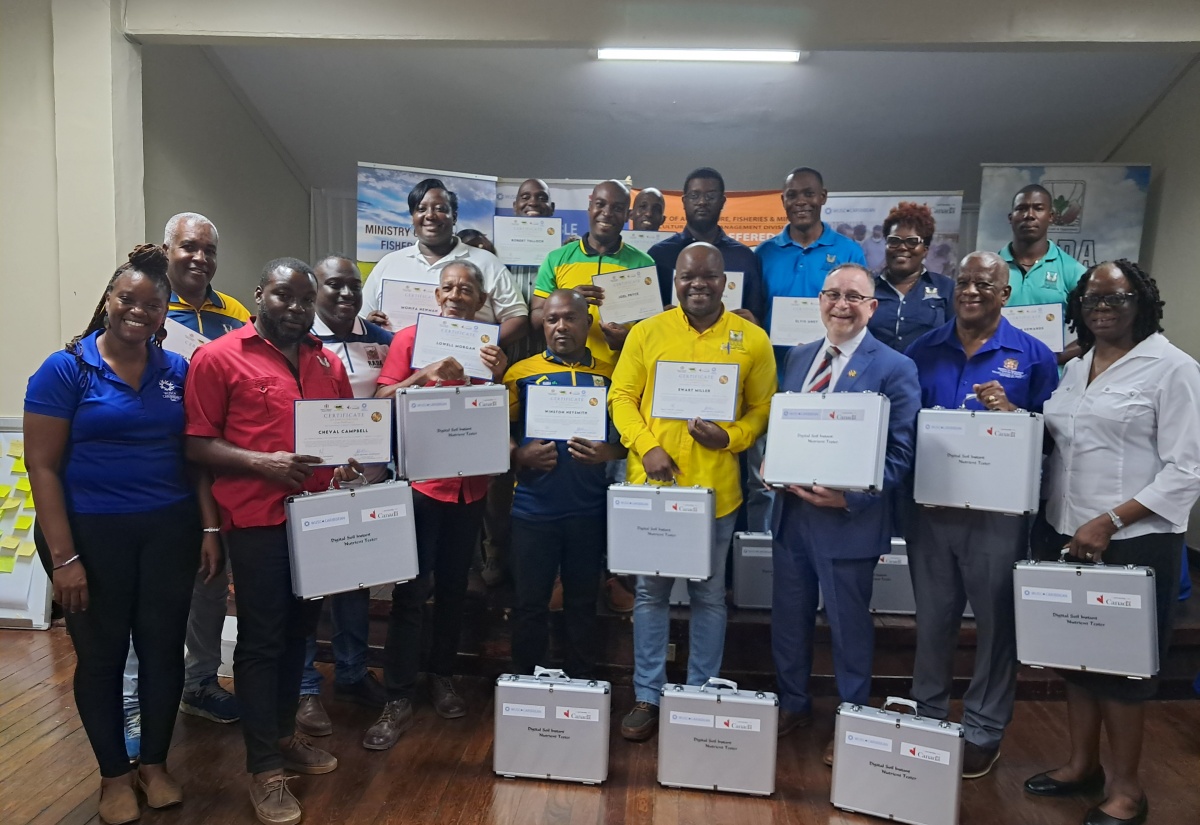
Photo: Britney Stevens
Minister of State in the Ministry of Agriculture, Fisheries and Mining, Hon. Franklin Witter (second right, front row); Canada’s High Commissioner to Jamaica, His Excellency Mark Berman (third right, front row); Senior Director of the Agricultural Land Management Division, Joan Brown-Morrison (right, front row); and Country Coordinator for the World University Service of Canada (WUSC) Caribbean, Nelsa English-Johnson (left, front row), share a photo opportunity with members of the Rural Agricultural Development Authority (RADA) who successfully completed a recent soil management training programme. The initiative was implemented through a partnership between the Agriculture Ministry and the WUSC) Caribbean, with funding from the Government of Canada. The group displays soil testing kits received during the closing ceremony, held on Tuesday (February 17) at the Liguanea Club in New Kingston.
Photo: Britney Stevens
Soil testing kits, which were handed over to representatives of agencies within the Ministry of Agriculture, Fisheries and Mining, who participated in a recent soil management training programme. The kits contain tools designed to support soil management. The presentation was made during the closing ceremony for the training programme, held at the Liguanea Club in Kingston. on Tuesday (February 17). The initiative was implemented through a partnership between the Agriculture Ministry and WUSC Caribbean, with funding from the Government of Canada.
Photo: Britney Stevens
Minister of State in the Ministry of Agriculture, Fisheries and Mining, Hon. Franklin Witter (left), converses with Canada’s High Commissioner to Jamaica, His Excellency Mark Berman, and Senior Director of the Agricultural Land Management Division, Joan Brown-Morrison, during Tuesday’s (February 17) closing ceremony for a soil management training programme, at the Liguanea Club in New Kingston. The initiative was implemented through a partnership between the Agriculture Ministry and the WUSC) Caribbean, with funding from the Government of Canada.The Full Story
Twenty-eight agricultural extension officers from across Jamaica have successfully completed an intensive two-day specialised soil management training programme, aimed at strengthening climate-resilient farming and improving agricultural productivity nationwide.
The officers were recognised during the programme’s closing ceremony at the Liguanea Club in New Kingston on Tuesday (February 17).
The initiative was implemented through a partnership between the Ministry of Agriculture, Fisheries and Mining and the World University Service of Canada (WUSC) Caribbean, with funding from the Government of Canada.
Speaking during Tuesday’s ceremony, Minister of State in the Agriculture Ministry, Hon. Franklin Witter, said the initiative is central to modernising agricultural extension services and supporting farmers’ livelihoods.
“The soil is the most important component in agriculture, because everything else that you put into agriculture is something that you’re adding to the soil,” he said.
Mr. Witter noted that soil management training represents a cornerstone of the Ministry’s strategy to transform extension services and promote evidence-based farming.
“This initiative not only strengthens productivity, but also enhances economic activity for our farmers,” he said, pointing out that climate change and recent hurricanes have underscored the need for improved soil management practices.
Through the project, the Ministry received 25 real-time soil testing kits, which will be distributed among key agencies, including the Rural Agricultural Development Authority (RADA), the Agricultural Land Management Division, the Research and Development Division within the Ministry, the Agro-Investment Corporation (AIC), and the Jamaica 4-H Clubs.
“Together, let us modernise extension services and empower our farmers for a more resilient and brighter future,” Mr. Witter urged the officers.
In his remarks, Canada’s High Commissioner to Jamaica, His Excellency Mark Berman, said the training forms part of a Can$20 million project supporting climate‑resilient agriculture across the Caribbean.
“By equipping the 28 extension officers with real-time soil-testing kits, we move from delayed laboratory diagnostics to immediate field-based evidence. There’s now a link between the science and the farmer’s field… a link that will lead to more precise fertiliser management, improved soil health and stronger farm productivity,” he said.
Mr. Berman described the programme as an example of the strong partnership between Jamaica and Canada, noting that the trained officers will help extend the impact of the investment across the agricultural value chain.
For her part, Senior Director of the Agricultural Land Management Division, Joan Brown-Morrison, said the training and new equipment will support more data-driven decision-making in the sector.
“These toolkits will help us collect real-time, reliable data to guide decision-making… we’re not guessing anymore. This is real, data-driven, technology-driven agriculture,” she said, adding that the tools will complement laboratory testing and strengthen national soil data collection.
Country Coordinator for WUSC Caribbean, Nelsa English-Johnson, emphasised that healthy soils are fundamental to agricultural productivity and resilience.
“You cannot manage what you cannot measure,” she said, noting that the training equips officers to provide timely, evidence-based advice to farmers and to strengthen national soil mapping and monitoring systems.
Mrs. English-Johnson added that Jamaica’s soils are under increasing pressure from climate change and unsustainable practices.
“Farmers are often applying fertilisers without knowing what the soil truly needs. Before you invest, do a soil test,” she underscored.
Through the Sustainable Agriculture in the Caribbean (SAC) Project, the Ministry has benefitted from the placement of two Canadian soil scientist volunteers at the Agricultural Land Management Division between November 2025 and March 2026.
Their work supports ongoing efforts to build a more resilient, climate-smart agricultural sector focused on long-term food security, higher yields, and sustainable rural development.