


Jamaica Enters New Era of Digital Transformation with Roll Out of National ID Card
By: , November 25, 2024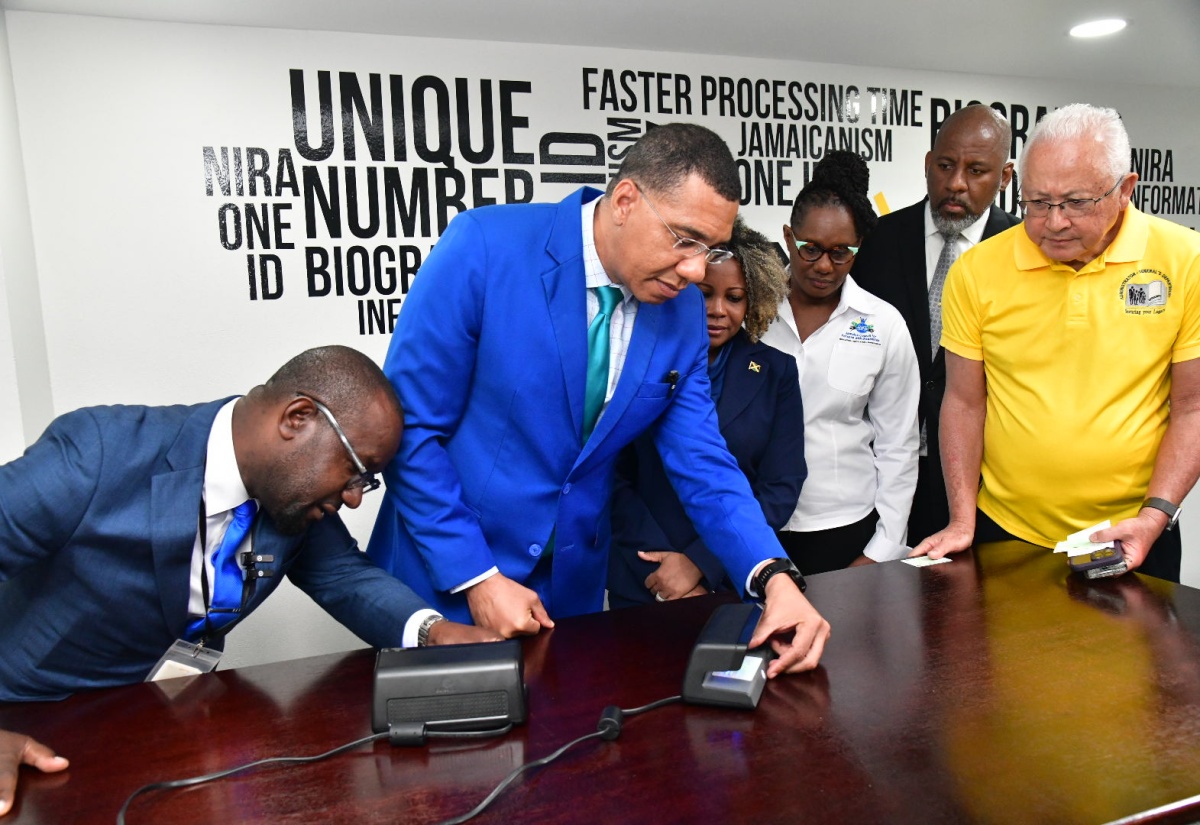
Photo: Michael Sloley
Prime Minister, Dr. the Most Hon. Andrew Holness (second left), is assisted by Programme Director for the National Identification System (NIDS), Dr. Warren Vernon, in the verification activity for the National Identification (ID) card, at the National Identification Registration Authority (NIRA) Personalisation Centre, located at Central Sorting Office in Kingston on November 15. Looking on (from third left) are Minister of Education, Skills, Youth and Information, Senator Dr. the Hon. Dana Morris Dixon; Executive Director of the Jamaica Council for Persons with Disabilities (JCPD), Dr. Christine Hendricks; Director General of the Planning Institute of Jamaica (PIOJ), Dr. Wayne Henry; and Minister of Justice, Hon. Delroy Chuck.The Full Story
Phased roll out of the National Identification System (NIDS) is underway, marking a new era in Jamaica’s digital transformation.
The digital system, which uses advanced biometrics technologies, provides a safe, secure, reliable and convenient form of ID, enabling seamless verification of a person’s identity.
It will be a gamechanger, improving the efficiency and accessibility of government services, while also addressing data privacy and cybersecurity concerns.
Prime Minister, Dr. the Most Hon. Andrew Holness, received his National ID card on November 15, as the official issuing of the first set of cards took place at the National Identification Registration Authority (NIRA) service centre located at the Central Sorting Office (CSO) in Kingston.
Their Excellencies, Governor-General, the Most Hon. Sir Patrick Allen and Lady Allen, were the first to receive their digital ID cards.
Also enrolling and collecting their cards were Minister of Education, Skills, Youth and Information, Senator Dr. the Hon. Dana Morris Dixon; Minister of Justice, Hon. Delroy Chuck; and Chairman of the Jamaica Umbrella Group of Churches, Rev. Courtney Gordon.
Approximately 300 individuals will be receiving their NIDS ID cards during this initial phase.
Once fully implemented, the national digital ID system will support various essential services, including voter verification, access to social services and healthcare, and secure financial transactions.
To enrol, persons are required to provide personal information and biometric data, including fingerprints and facial images.
Programme Director for NIDS, Dr. Warren Vernon, said the national ID is the most secure electronic nationalised card in the country.
“Not only is it secure, but it is the first document that is supported by a very strong legal framework,” he said, referencing the laws and penalties for breaches.
In addition to electronic verification, Dr. Vernon noted that there are security features to ensure physical authentication of the card “because you’re not always going to have the ability to…check back to the government database.”
“At the back of the card you have the map of Jamaica. If you flip it, you are seeing that it changes between green, black and gold,” he said.
Prime Minister Holness, in emphasising the security features, said that “no one will be able to replicate the card”.
“No one can go into some back corner store somewhere and pay somebody to come up with a NIDS. That’s not going to be possible, that is like 99.9 per cent impossible, based upon all the technologies that we have used to create this card,” he assured.
Dr. Vernon pointed out that the card is inclusive, with special features for persons with disabilities.
“The Jamaica Council for Persons with Disabilities (JCPD) spent hours negotiating and discussing to determine what we would place on the card and finally they decided that we would put the international access sign at the bottom of the card. The reason for this is to not disclose what the disability is, but once the card is presented, you know that the person has a disability,” he informed.
“This provision alone will save the government of Jamaica approximately $400 million,” he noted.
In addition, the NIDS card will include a feature to verify Justices of the Peace (JPs), which Dr. Vernon said, will also save the government “a fair amount of money”.
The national ID surpasses existing identification documents such as passports, electoral IDs, and driver’s licences.
The Programme Director emphasised that persons should not be asked to provide any other form of ID when the national ID card is presented.
“You will be able to use it to do multiple things; prove who you are in terms of identity, but also be able to use this card to access certain government services,” Dr. Vernon noted.
The National ID can also be used for proof of life for government pensioners. “You can read the information that is stored on the card and compare it with the person standing before you, using near-field communication (NFC),” he pointed out.
NIDS will involve the issuance of a unique, lifelong National Identification Number (NIN) to every person.
Dr. Vernon explained that the NIN is identical to the Tax Registration Number (TRN), which means that “the State is not going to issue a new number to you; you are going to be able to use your existing number to enrol for your national identification card.”
Meanwhile, Chairman of the National Identification Registration Authority (NIRA), Bishop the Hon. Conrad Pitkin, advised that there will be 24 NIDS enrolment centres across Jamaica.
He said contracts have been signed for eight “and those will be commissioned first.”
“We are in the process of signing another 15 contracts, and so before the middle of the year, we should have all our service centres across Jamaica ready. I am pleased to announce that there will be a mobile unit [to] reach persons in deep rural Jamaica,” he said.
Bishop Pitkin said the enrolment centres will be located at post offices across the island.
“Because of the type of equipment and the value of the equipment that we are using, it is best that there are in a government building,” he explained.
Regarding the enrolment of persons with disability with no limbs or fingerprints, Bishop Pitkin said NIRA is in dialogue with the JCPD on the matter.
“They might not have the fingerprints, but there will be facial image and some of them actually can sign,” he pointed out.
NIDS is a voluntary programme that aims to reduce identity theft, facilitate inclusion and ease of transactions, and improve governance and management of social, economic and security programmes.