


Jamaican Inventors Turn Local Sorrel Challenge into Global Solution
By: , December 24, 2025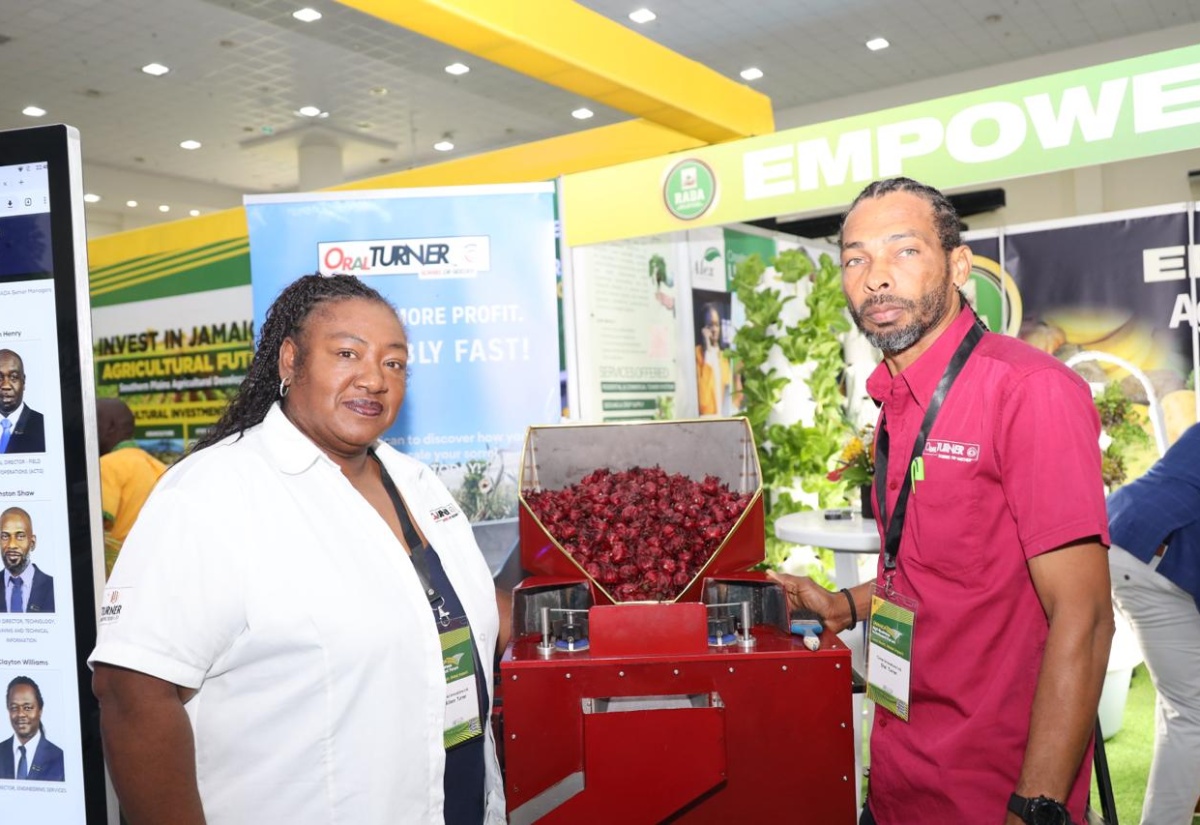
Photo: Contributed
Inventors Allison and Oral Turner with their Sorrel Deeseeder.The Full Story
What started as a simple question about why sorrel farmers were struggling to turn a profit has evolved into a Jamaican-made invention with the potential to reshape a global agricultural industry.
For husband-and-wife team, Oral and Allison Turner, co-owners of Turner Innovations Limited, the journey into innovation has been marked by perseverance, faith and a refusal to accept that a long-standing farming challenge had no solution.
“We didn’t choose sorrel; sorrel came to us,” Mrs. Turner tells JIS News.
She recalled that the idea for what is now the Oral Turner™ Sorrel Deeseeder emerged when a farmer visited her husband’s retail community farm store in Comma Pen, St. Elizabeth with, a challenging situation.
“A customer came in one day and he was going to abandon a sorrel crop because he thought the cost to reap would have been more than the profit he would have made,” Mrs. Turner says.
That encounter prompted the Turners to take a closer look at the economics of sorrel production and revealed a problem that had long burdened farmers.
“We realised that the reaping cost accounted for half of the cost of the crop and no solution was available around the world,” she tells JIS News.
With sorrel cultivated across more than 50 subtropical countries and still largely harvested by hand, the couple became convinced that innovation was not only possible, but necessary.
“So, we decided that there must be a solution to this problem and we started to play with different ideas to make it less tedious and costly because of the labour,” she said.
Founded in 2009, Turner Innovations Limited has since devoted more than 16 years to developing that solution.
After months of early experimentation, the Turners produced an initial prototype, marking the beginning of a long and demanding innovation journey.
One of the most formidable challenges came in sourcing the precise materials required to separate the sorrel calyx from the seed without damaging the flesh.
“The biggest problem that we found was finding the raw materials like the right shape blades,” Mrs. Turner tells JIS News, noting that with limited options available, they relied on ingenuity and persistence.
“We overcame this by manually cutting each of the 600 plus blades by hand on our first prototype,” she says, noting that the process was painstaking.
“It took about five weeks to complete with us sitting down for hours each day using razor blades to make the blades, the shape that we wanted them [to be in],” she points out.
While the early prototypes demonstrated progress, they also exposed limitations that threatened product quality.
Early prototypes focused on cutting the sorrel to remove the seed, but this approach created new challenges.
“The problem was the more cuts made to remove the flesh from the seed, the shorter the life was of the span of the sorrel,” Mrs. Turner says.
Nevertheless, the inventors pressed on and that challenge led to a critical redesign. Instead of multiple cuts, the solution lay in a single, precise motion.
The resulting feed-and-cut system allows each bud to be processed individually, preserving the calyx while efficiently removing the seed.
“Each bud is singly fed into a prong system that grips, cuts and separates the calyx flesh from the seed bud, then they are separated for easy handling,” Mrs. Turner tells JIS News, boasting that this is an outcome that is unmatched globally.
“It is the only machine in the world that has achieved this,” she says.
With a major goal achieved, the Turners commenced extensive field testing, beginning in Jamaica, where the machine’s performance quickly impressed farmers.
“Yes, we did a lot of field testing in Jamaica and continue to do field testing. The local farmers were surprised at the speed at which it worked,” Mrs. Turner says.
That success soon attracted international interest, including farmers in Australia. The following year, the Turners visited Australian farms during the sowing season to observe the machine in use.
“Labour costs are very high in Australia and the farmers loved that they could increase production speeds at least two times faster and reduce their labour costs by half,” Mrs. Turner tells JIS News, adding that the response from operators was positive and decisive.
“Machine operators remarked that they would not want to go back to the old methods of stripping sorrow,” she recalls.
While sorrel is deeply rooted in Jamaican culture as a traditional beverage, Mrs. Turner notes that its value extends far beyond the island.
“Sorrel…has many applications in other countries, such as herbal teas, pharmaceutical uses, chutney, cooking and cosmetics,” she points out, also highlighting the crop’s health benefits.
“It [also] has medical values, such as rich in antioxidants and its cancer and high blood pressure fighting properties,” Mrs. Turner adds.
Meanwhile, the inventor pointed out that as global interest in the invention grew, protecting the intellectual property became essential.
“Patenting is very important for any invention,” Mrs. Turner underscores.
She noted that support from the Development Bank of Jamaica (DBJ) played a key role in securing that protection.
“We have been very blessed to receive grant funding to help us patent our invention under the Boosting Innovation, Growth & Entrepreneurial Ecosystems (BIGEE) programme. That has helped to secure a Jamaican patent, a United States of America (USA) patent and a world patent,” she says.
The BIGEE Programme provides grant funding and technical support to help Jamaican innovators move ideas from concept to market.
The initiative supports activities such as research and development, product refinement and intellectual property protection, strengthening the country’s innovation ecosystem and improving the global competitiveness of local enterprises.
As development progressed, the Turners strengthened their business capacity through training at the Branson Centre of Entrepreneurs and partnerships with venture capitalists including First Angels Caribbean. This support helped solidify the company’s business framework as Turner Innovations Limited transitioned from prototype development to manufacturing, culminating in the official launch of the Oral Turner™ Sorrel Deeseeder in January 2024.
Progress was briefly slowed by Hurricane Melissa, which caused widespread damage across St. Elizabeth.
“Hurricane Melissa was such a devastation for Jamaica, especially on our side of the island, ” she notes.
While their loss was limited, the wider agricultural impact affected local sales.
“It slowed down our sales movement for Jamaica because I think a lot of crops were damaged,” she explains.
Despite the setback, the experience strengthened the Turners’ resolve.
“We’ve proven to ourselves that no problem is impossible to solve, no matter what the odds,” Mrs. Turner tells JIS News.
Looking ahead, the Turners, who have been married for more than 21 years, remain focused on innovation, manufacturing and continuous improvement, with growing international interest in the technology.
Beyond commercial success, Mrs. Turner says the ultimate goal is to inspire future Jamaican inventors.
“Our legacy will be that we put Jamaica on the map for invention and left a path for others to follow,” she tells JIS News.
“Invention is not an easy road. You need to be 100 per cent committed to your dream,” she says.
“My favourite motto is ‘never take no for an acceptable answer’. Where there’s a will, there’s always a way and last but not least, put God before every step and decision you make,” Mrs. Turner stresses.