



Resilience in the Rubble: Doctors Without Borders Praises Jamaica’s Determination to Rebuild
By: , November 18, 2025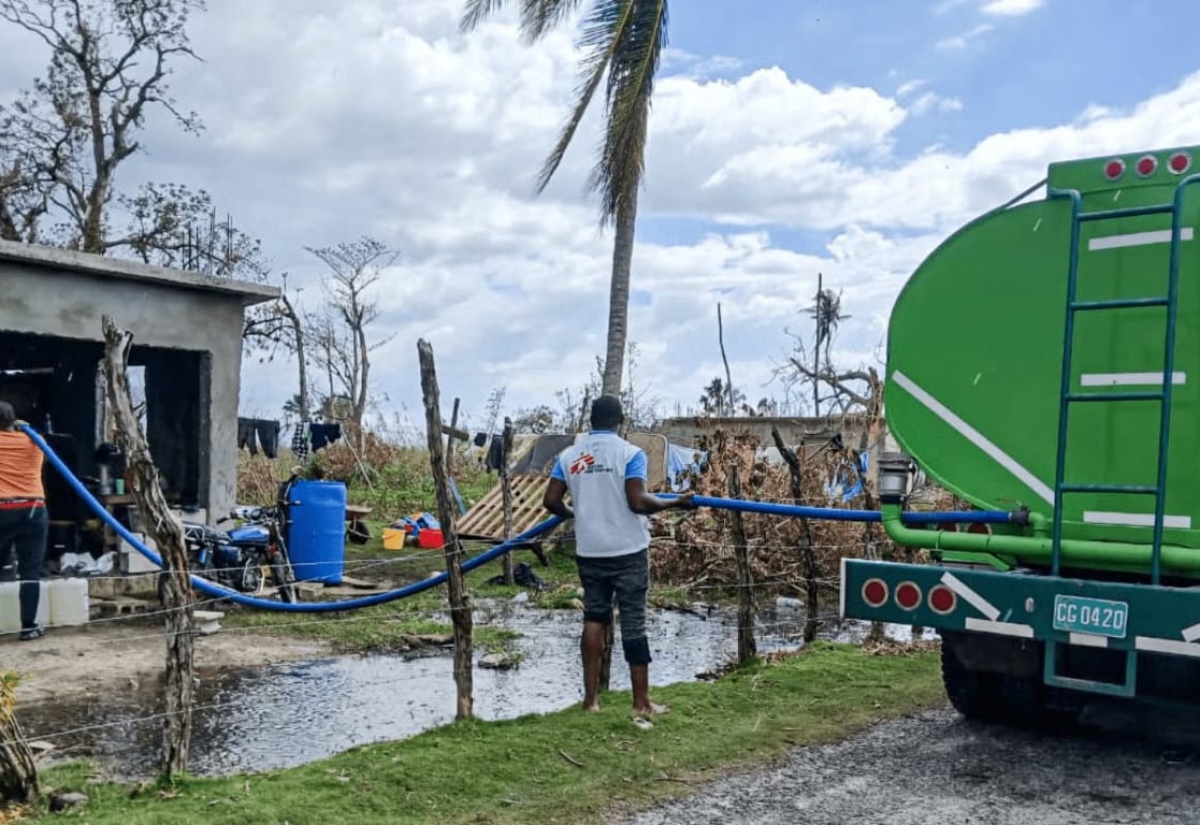
Photo: Contributed
Members of the Doctors without Borders team truck water to homes in Slipe, St. Elizabeth.The Full Story
In the aftermath of Hurricane Melissa, Cornwall Regional Hospital in St. James buzzed with activity as staff and volunteers cleaned and cleared debris strewn throughout the hospital building and grounds to ensure patient safety and continuity of care.
Amid the rain-soaked wards, doctors, nurses, and ordinary Jamaicans continued to work, not in despair but in defiance of it.
For Head of Mission for Doctors Without Borders/Médecins Sans Frontières (MSF), Estifanos Mengistu, this resilience is nothing short of extraordinary.
“When we went the first time to Cornwall Regional Hospital, the roofs of the maternity ward and laboratory blocks were blown off completely. Yet, despite the rain pouring in, the staff continued to serve the mothers and babies. They recognised the challenges but they never gave up. That level of resilience really moved me,” he recalls.
It is this spirit that drew Doctors Without Borders to Jamaica for the very first time in the organisation’s 50-year history.
Although the medical humanitarian agency operates in more than 70 countries, it had never needed to intervene here, a fact Mr. Mengistu says, speaks volumes about Jamaica’s strength and capability. However, when forecasts showed Hurricane Melissa’s intensity increasing, the organisation knew it had to act.
“We knew Jamaicans and their authorities are capable and resilient, but the magnitude we saw was heavy. Once it hit, we realised the people would need support, and it was our duty to extend our hand,” he points out.
Before the hurricane made landfall, Doctors Without Borders teams began preparing. Team members converged from their missions all over the world in Brussels, Belgium, then to Santo Domingo in Dominican Republic, where they waited to travel to Jamaica.
They chartered a cargo plane with medical and logistical supplies, zinc sheets, tarpaulins, hygiene kits, water containers, and medicines, ready to deploy at a moment’s notice.
The team landed in Kingston just 48 hours after the storm cleared Jamaican airspace.
“It wasn’t easy,” Mr. Mengistu admits. “We arrived Saturday evening, November 1, and our cargo plane followed two days later. Thanks to the authorities, clearance was immediate,” he tells JIS News.
The team of 15 specialists, doctors, water and sanitation engineers, logisticians, and coordinators, is offering support in the most-impacted parishes, starting with St. James and St. Elzabeth.
The approach of Doctors Without Borders has been one of partnership rather than replacement. Instead of setting up independent field hospitals, the organisation works side-by-side with Jamaica’s Ministry of Health and Wellness to restore essential services.
“We are here to strengthen the local system. From the parish level up, we help them recover quickly, clean up facilities, repair roofs, and restart healthcare services, even if only partially, so that life can resume,” Mr. Mengistu explains.
In St. James, teams are repairing damaged hospital roofs, assisting with waste clean-up, and restoring safe conditions for staff and patients. In St. Elizabeth, they have launched mobile clinics, set up tents to deliver primary healthcare, and provided clean water to isolated communities.
Beyond medical care, the group is distributing hygiene kits, tarpaulins, and basic necessities to families sheltering in schools and churches.
Mr. Mengistu identifies the most critical needs on the ground as healthcare, clean water, and mental health support.
“People with chronic diseases, hypertension, diabetes, are running out of medicine. Clinics are damaged, roads are cut off. We’re helping restore access but mental health is also vital, both for survivors and for health workers who have endured trauma,” he points out.
He notes that there are also concerns about the waste left by the hurricane and the pools of stagnant water everywhere.
“That creates mosquito breeding sites and infection risks. Waste management, hygiene, and sanitation are urgent priorities,” Mr. Mengistu says.
However, amid all the challenges, what has struck Mr. Mengistu most deeply is the compassion of Jamaicans themselves.
“I have done this job for 22 years, and the welcome here has been heart-warming. At Cornwall Regional Hospital, we began cleaning the compound, and immediately, a bus full of volunteers arrived to help. Even when I go to a shop for a bottle of water, people are kind, grateful, and supportive. It’s more than words can express,” he says.
That spirit of solidarity fuels MSF’s determination to keep going despite challenges of poor connectivity, damaged roads, heavy traffic, which have slowed progress.
“Sometimes the team gets stuck for hours in traffic or must turn back because of a washed-out road, but still, everyone is eager to do more. Nothing has stopped us,” Mr. Mengistu tells JIS News.
For now, Doctors Without Borders plans to continue operations in Jamaica until the end of December, focusing on emergency recovery and health-system reinforcement.
“We see a strong and capable system. If we fill the urgent gaps, Jamaicans can take it forward,” the head of mission says.
Still, he remains open to extending the mission if needed, in close consultation with the Ministry of Health and Wellness.
His message to the international community is one of solidarity and shared responsibility.
“The devastation is big, and rebuilding requires investment,” he says. “Everyone – governments, donors, citizens, can help Jamaica return to its pre-hurricane strength and prepare for the future.”
Above all, Mr. Mengistu says, the experience has revealed the soul of Jamaica, a people who meet hardship with humility, courage, and unity.
“Their resilience, their humility, their solidarity – that’s what stands out everywhere we go,” he reflects.
To those who have lost everything, his message is simple but profound.
“You are not alone. Many international partners are here, and we are with you. We will do as much as we can, with compassion, with respect, and with hope,” he assures.
As sunlight breaks through the storm-torn clouds over the island, that hope, shared by doctors, volunteers, and survivors alike, is the clearest sign yet that Jamaica’s recovery has already begun.